
From Spreadsheets to DMS: Why Excel Eventually Breaks
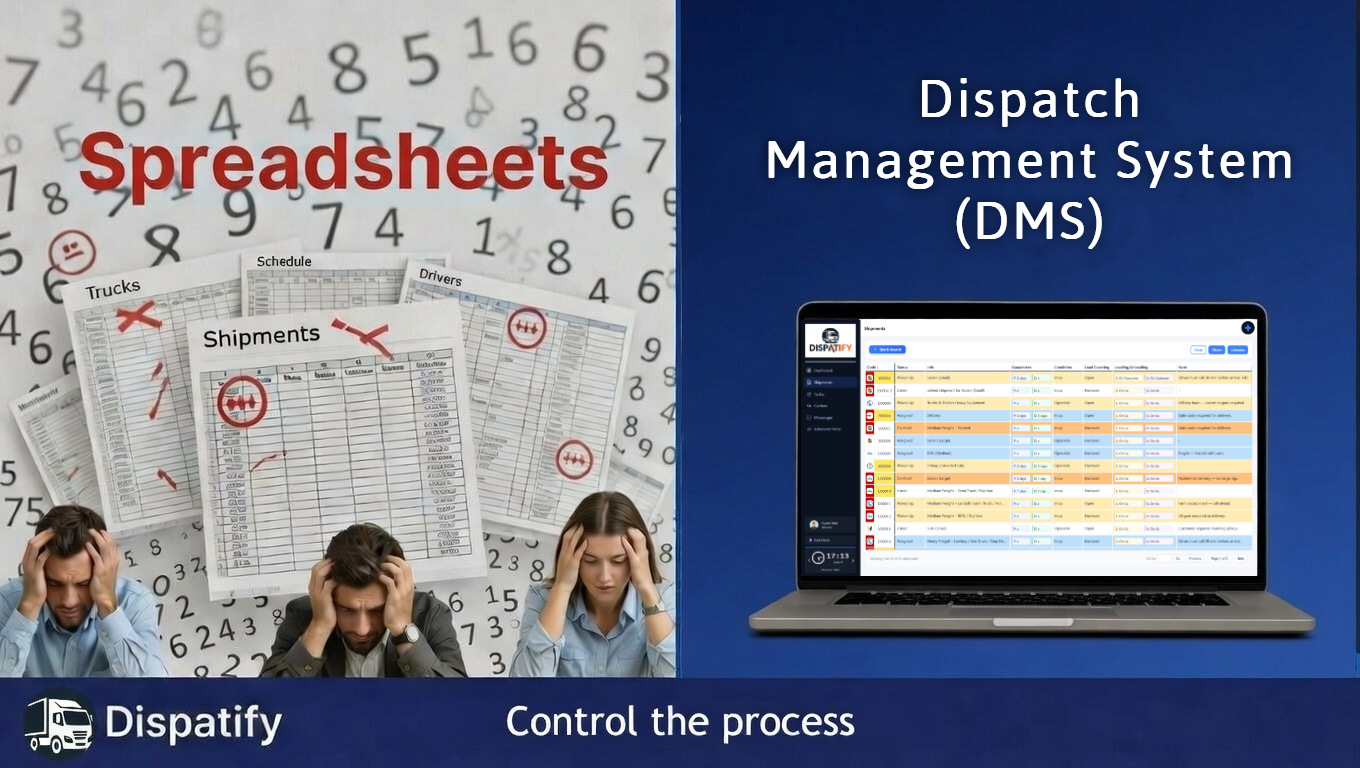
For years, spreadsheets have been the backbone of logistics operations. They're familiar, flexible, and cheap. In the early days, they worked just perfectly. But despite all of that, spreadsheets have one big problem.
They don't fail loudly. They fail quietly.
If you're a broker, carrier, or any other logistics operation still running your loads using Excel or Google Sheets, the real question isn't "Why should I give up the spreadsheets?" It's "How long before they stop working, and what does that cost me?"
Why spreadsheets feel like the right move
What is good?
Spreadsheets are attractive because they give a sense of control: you can customize anything, move fast, skip onboarding, and everyone on the team already "knows Excel." At low volume (say 5–15 loads per week), that's fine.
What is bad?
The problem is that spreadsheets scale linearly, while logistics complexity scales exponentially. Every new shipment brings manual data entry, human error, permission-based problems, and silent errors.
The first thing that breaks: visibility
In a spreadsheet-based operation, one person lists the shipment, another updates the load status, another tracks carrier info, and someone else handles billing. Now ask a simple question:
"What's the load's status right now, and what's the margin on it?" If the answer takes more than a split second, that's not a fine-tuned system. That is a complete mess.
A Dispatch Management System (DMS) centralizes this by design. Loads, statuses, documents, profits, and contacts live in one system - partially automated and visible in real time.
Scalability: the main problem with the spreadsheets
They break when you grow!
Spreadsheets don't break because you're bad at logistics. They break because you're getting better at it - better client flow, client return rate, etc. That introduces more employees, more customers, more carriers, and more places where human error can mess everything up.
Spreadsheets rely on tribal knowledge: "Only Sarah edits this tab." "Don't touch that formula." "Make a copy before you change anything." That physically can't work since you scale.
A DMS built for big multi-user operations - role-based access, standardized workflows, consistent data structures, etc. - is what allows brokerages and carriers to grow without losing control or quality. Myths like "But Excel is more flexible" are dangerous because that flexibility comes from a lack of structure and eventually means lost shipments, negative reviews, manual workarounds, operational debt, and inconsistency.
When is the right time to move to a DMS?
Here is the reality:
- If you're running a handful of loads per week → spreadsheets are just fine.
- If not screwing up depends on luck → you're long overdue.
- If you're juggling multiple agents, customers, and carriers → you're already feeling the cracks, and remember that it will get only worse.
So, if you just found yourself in a situation where you need a quality DMS, Dispatify is your choice.